


The Project Prometheus AI startup marks Jeff Bezos’s return to operations as co chief executive alongside Vik Bajaj. This venture aims to deliver AI for the physical economy, transforming engineering and manufacturing workflows. Moreover, the company will focus on computers, aerospace, and automobiles where simulation matters. Its approach resembles Periodic Labs, because it plans to simulate the physical world to train AI models. Investors have already committed billions, and the team includes researchers from Meta, OpenAI, and Google DeepMind.
However, Prometheus will tackle hard engineering problems, not just software or cloud services. The emphasis on physical systems sets this startup apart in the AI industry. Therefore, breakthroughs here could speed product development in aviation and vehicle manufacturing. Bezos’s operational return gives the project strategic heft, and Bajaj brings deep technical leadership. As a result, the startup may bridge advances in AI models with practical industrial design. For investors and engineers alike, Project Prometheus offers a rare blend of ambition and real world focus. In the sections that follow, we will explore funding, talent, technical goals, and industry implications.
Project Prometheus AI startup takes a distinct approach to industrial AI. Jeff Bezos and Vik Bajaj lead the venture. Bezos returns to operations and backs the company with billions. The startup has raised about $6.2 billion in funding. Because it focuses on the physical economy, its goals differ from consumer AI projects.
The technological foundation blends physics simulation, digital twins, and large models. In practice, teams will simulate complex systems to train AI models. Researchers from Meta, OpenAI, and Google DeepMind already work there. In addition, Vik Bajaj brings experience from Verily and Google’s life sciences projects. The company describes its mission as “AI for the physical economy” on LinkedIn, and aims products at engineering and manufacturing.
Key elements of Prometheus’s approach include:
- Physics informed simulation to model aerospace and automotive systems.
- Digital twins to speed iterative design and testing.
- Tight hardware software integration for real world deployment.
- Focused AI products for computers, aerospace, and automobiles.
- A rapid research to product pipeline backed by sizable capital.
Therefore, the startup could shift how companies design and build hardware. For example, factories might use Prometheus models to cut development time. Moreover, its scale and talent pool give it strategic weight in the AI landscape. For background on related teams and past projects, see Verily and The New York Times. Learn more about Prometheus on its LinkedIn page at Prometheus LinkedIn.
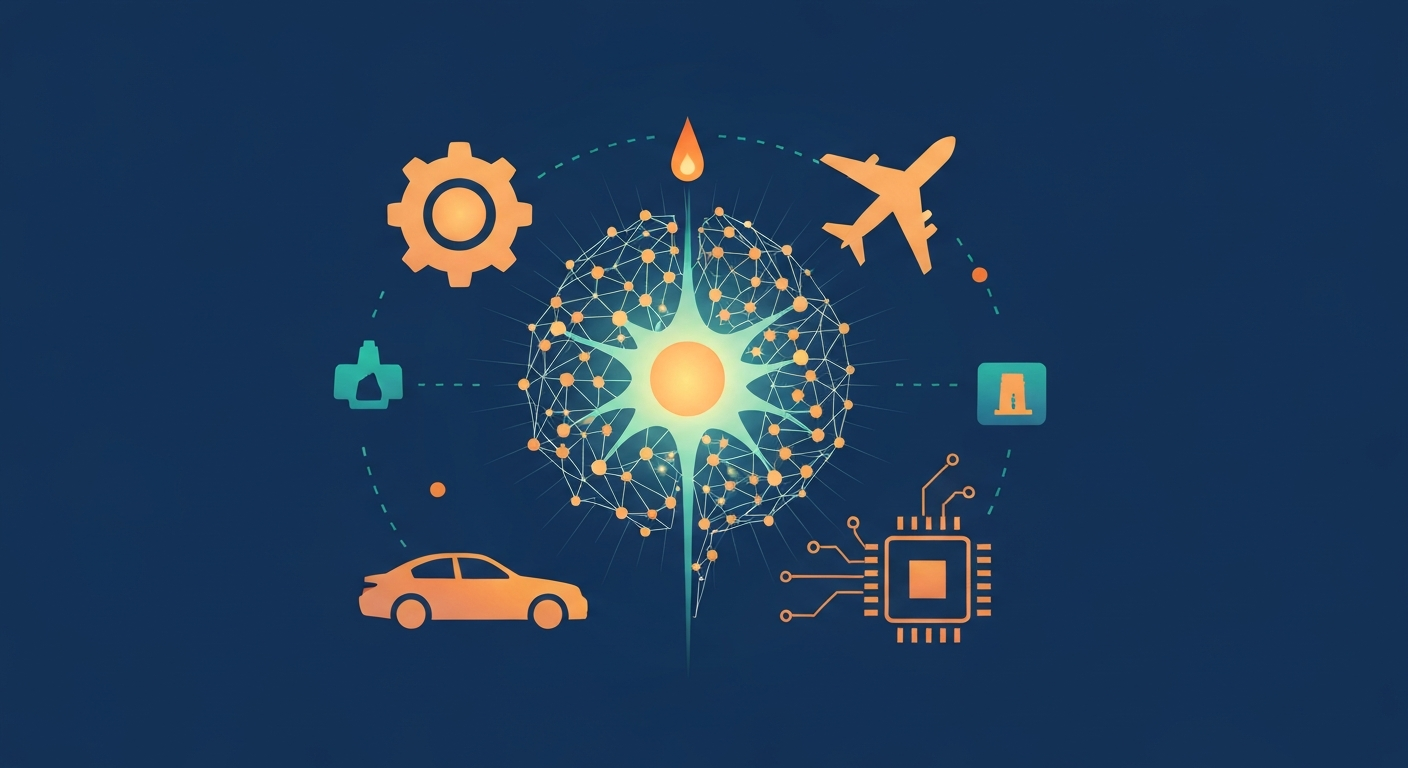
Image sourced for the article to visually represent AI innovation and breakthroughs
Project Prometheus AI startup has posted early signals that support its ambitious goals. Jeff Bezos and Vik Bajaj co-lead the firm, and investors committed roughly $6.2 billion. Because of that capital, the company can hire top researchers and build simulation infrastructure. The team already counts nearly 100 staff, including engineers from Meta, OpenAI, and Google DeepMind. Moreover, Vik Bajaj brings experience from Verily and Google’s life sciences work, which helps the company bridge lab scale research and industrial products.
Milestones and funding
- Raised about $6.2 billion in initial funding, giving it runway for hardware scale experiments.
- Recruited almost 100 researchers and engineers from Meta, OpenAI, and Google DeepMind.
- Announced dual leadership with Jeff Bezos returning to operations and Vik Bajaj as co-CEO.
Early technical evidence
- The firm focuses on physics-based simulation and digital twins, which can reduce physical prototypes.
- Its approach resembles Periodic Labs, because both simulate the physical world to train models.
- Initial internal projects reportedly target computing hardware, aerospace components, and automotive systems.
Partnerships and credibility
- Leadership and staff ties to Amazon, Google, and Verily strengthen domain knowledge and partnerships.
- For context on related life sciences leadership, see Verily, which shows similar talent flows.
- Media reporting from major outlets, including The New York Times, added independent confirmation.
Concrete examples and impact
- If simulation can cut prototype cycles by half, manufacturers could save months and millions.
- As a result, aerospace and auto designers may shorten certification timelines.
- Therefore, early hires and deep capital give Prometheus a credible path to productization.
These data points and examples build a case that Project Prometheus can move from research to real world AI products.
Executive summary: Prometheus pairs large capital with simulation expertise to target physical systems; peers differ by domain and funding.
- Project Prometheus: Physics simulation and digital twins; Market focus: Computers, aerospace, automobiles; Funding scale: ~$6.2B; Innovation edge: AI for the physical economy; hardware software integration.
- Periodic Labs: Physics informed lab simulation; Market focus: Scientific discovery and research acceleration; Funding scale: ~early-stage venture backing; Innovation edge: Simulation to accelerate experiments; closes model-to-lab loop Periodic Labs.
- DeepMind: Large scale ML and reinforcement learning; Market focus: Foundational AI research, cross-industry applications; Funding scale: ~corporate funded by Alphabet; Innovation edge: Breakthrough algorithms with research-to-product transfer DeepMind.
- Anthropic: Safety focused large language models; Market focus: Enterprise AI and AI safety research; Funding scale: ~institutional and VC backing; Innovation edge: Emphasis on safety and interpretability Anthropic.
Project Prometheus AI startup represents a major push into AI for the physical economy. Jeff Bezos and Vik Bajaj lead the venture. The company already counts nearly one hundred researchers. Because it blends physics simulation, digital twins, and large models, it targets hard engineering problems rather than consumer software. Therefore, its work could reshape engineering and manufacturing workflows across computers, aerospace, and automobiles.
Prometheus’s early funding and hires give it runway to build hardware scale systems. Moreover, its recruitment from Meta, OpenAI, and Google DeepMind adds research credibility and speed. As a result, companies may see shorter prototype cycles and faster certification timelines. The model to product pipeline looks promising, yet execution remains the key variable.
Follow developments closely, because breakthroughs here could change industrial design and production. Subscribe or check major outlets for updates, and watch how Prometheus translates research into real world products. In short, Project Prometheus could become a landmark AI startup to watch in the coming years.
Frequently Asked Questions (FAQs)
What is the purpose of Project Prometheus AI startup?
Project Prometheus aims to build AI for the physical economy. It focuses on engineering and manufacturing. The startup targets computers, aerospace, and automobiles to speed design and production.
What core technologies does the company use?
Prometheus combines physics simulation, digital twins, and large AI models. These tools let teams simulate real world systems before building hardware. As a result, the company can reduce physical prototypes and accelerate testing.
What impact could Prometheus have on industry?
The startup could shorten development cycles and cut costs for manufacturers. Moreover, it may speed certification in aerospace and auto sectors. Therefore, engineering teams could iterate faster and bring safer products to market.
How is the venture funded and who leads it?
Investors committed roughly six point two billion dollars in initial funding. Jeff Bezos and Vik Bajaj share co CEO duties. Their leadership and deep capital give the firm strong runway.
How does Prometheus differ from other AI startups?
Unlike consumer focused AI companies, Prometheus centers on physical systems. It prioritizes hardware software integration and industrial workflows. However, it still hires top researchers from Meta, OpenAI, and Google DeepMind, which boosts its research strength.
