


AI-powered warfare has emerged as a pivotal development in global security, reshaping strategic planning and market forecasts. Because advanced machine learning now drives autonomous systems, kinetic operations and cyber campaigns, defense priorities are shifting rapidly. Governments allocate resources to software, sensors and data infrastructure, and defense contractors reposition portfolios. However, investors and supply chain managers face new volatility because capital now chases both hardware and AI services. Market implications include accelerated mergers, revised sovereign procurement and elevated risk premia for firms exposed to contested geographies. This dynamic touches autonomous drones, AI targeting, cyberattacks and state backed disinformation campaigns that can amplify strategic effects. Analysts warn that rapid operationalization of autonomy and targeting raises ethical concerns and escalation risks, prompting regulatory pressure. As Sundar Pichai observed, “I think no company is going to be immune,” therefore corporate resilience planning has moved to the center of board agendas.
Strategic impacts of AI-powered warfare
AI-powered warfare is recalibrating the calculus of force employment and strategic posture worldwide, and it does so with speed because machine learning compresses decision cycles. Commanders increasingly rely on algorithmic targeting and autonomous sensors to achieve tempo advantages, therefore traditional hierarchical command structures are adapting to distributed, data driven nodes. As a result, militaries pursue composable force packages that emphasize redundancy and interoperability rather than platform centrality.
Key tactical shifts include
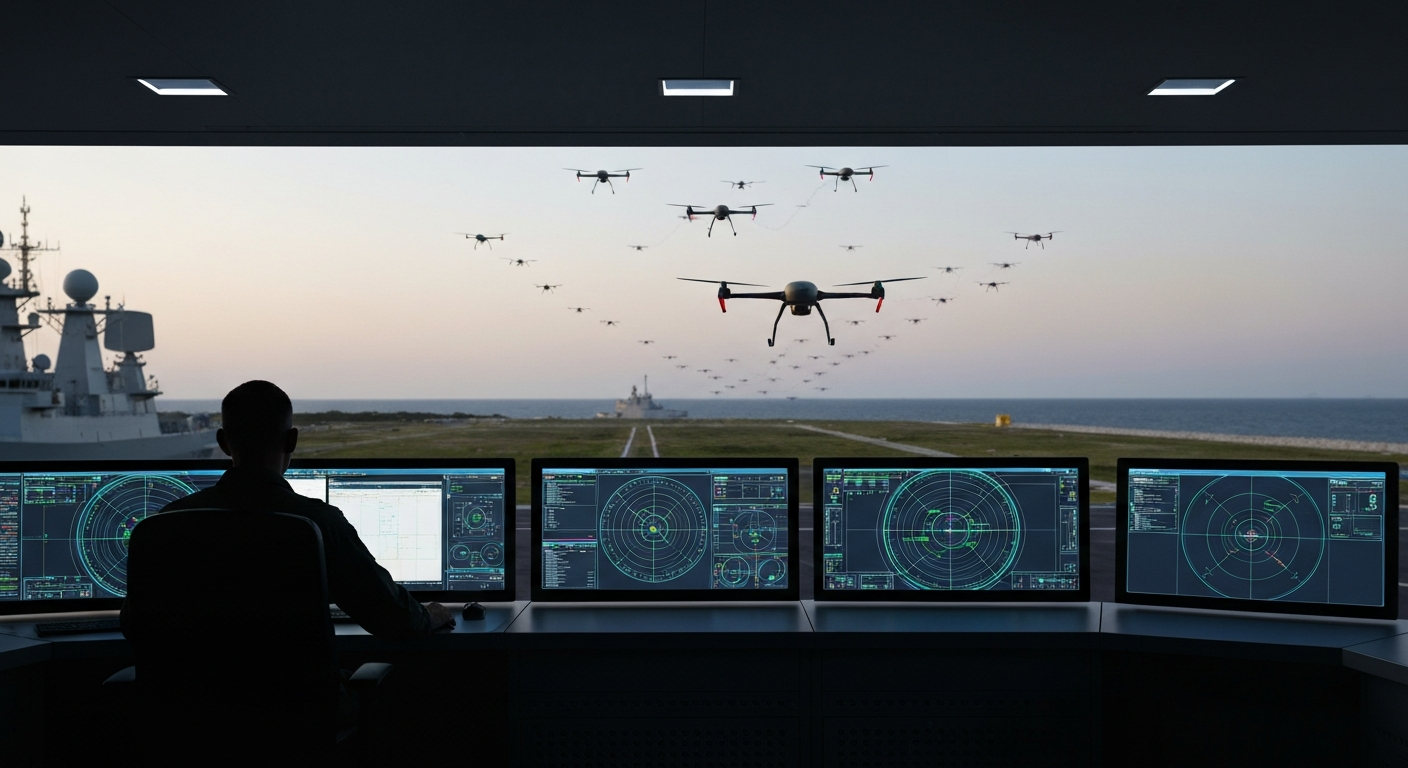
- Greater reliance on autonomous drones and swarm tactics to impose operational depth and attrition.
- Increased use of predictive analytics for logistics and mission planning, which shortens sustainment timelines.
- Integration of cyber operations and AI enabled influence campaigns to shape information environments and erode adversary cohesion.
Nation state programs illustrate the strategic intent. The United States has advanced composable doctrine through Mosaic Warfare concept, which aims to integrate low cost, autonomous systems into mission architectures.
Western procurement also reflects persistent concerns about supply chains, because policymakers have sought export controls to deny adversaries advanced AI chips Blocking China’s access to AI chips matters for US national security.
Moreover, controversies around Project Maven and allied contracts underline operational security risks, as recent reporting shows industry exposed by breaches and service dependencies Startup working on contentious Pentagon AI project was hacked.
Geopolitically, AI driven capabilities recalibrate deterrence by lowering the cost of precision operations, and they raise escalation risk because actions can occur at machine speed. Consequently, defense budgets shift toward software, sensors and secure data infrastructures, and firms must reassess procurement strategies and portfolio exposure.
The table below situates prime vendors by technology focus and recent deployments. It supports stakeholder assessment of the AI-powered warfare market.
Anduril
Technology focus: Autonomous systems, swarm management, AI targeting. Anduril
Recent contracts or deployments: Prototypes and fielded systems for US Department of Defense and homeland security pilots. See Anduril
Comparative strategic advantages: Software first, rapid fielding, startup agility; therefore fast iteration cycles.
Lockheed Martin
Technology focus: Integrated air platforms, systems integration, AI-enabled mission systems. Lockheed Martin
Recent contracts or deployments: Ongoing F-35 software modernization and classified autonomy programs. See Lockheed Martin
Comparative strategic advantages: Scale as prime integrator, deep program management, established supplier networks.
Raytheon Technologies
Technology focus: Sensors, missile defense, electronic warfare and AI signal processing. Raytheon Technologies
Recent contracts or deployments: Deployed air and missile defense upgrades and sensor suites with AI components. See Raytheon Technologies
Comparative strategic advantages: Sensor depth, EW expertise, defensive systems portfolio; consequently strong position in layered defense.
Northrop Grumman
Technology focus: Autonomy for unmanned systems, C4ISR, secure communications. Northrop Grumman
Recent contracts or deployments: Contracts for unmanned platforms and C4ISR modernization. See Northrop Grumman
Comparative strategic advantages: Platform heritage, integrated systems, secure data architectures.
BAE Systems
Technology focus: Electronic warfare, avionics, AI-enabled ISR. BAE Systems
Recent contracts or deployments: International procurement contracts and EW system deliveries. See BAE Systems
Comparative strategic advantages: Global footprint, export experience, diversified defense product lines.
Economic and market implications of AI-powered warfare
AI-powered warfare is reshaping defense economics because governments redirect capital toward software, sensors and secure data infrastructure. Defense ministries substitute legacy procurements for modular systems, and as a result budget lines shift from platforms to capabilities. Market estimates show rapid growth; analysts at Global Growth Insights value the AI in military market at $8.25 billion in 2024, rising toward $10.16 billion by 2026. Another forecast places the broader AI in aerospace and defense market on a path to 65.43 billion by 2034. Meanwhile overall military expenditure remains elevated, with SIPRI reporting global spending near $2.44 trillion in 2023.
Key market effects include
- Repricing of defense contractors because recurring software revenue gains priority over single platform sales.
Source: Global Growth Insights
- Increased M&A and strategic partnerships, as firms buy AI stacks and data capabilities to accelerate time to deployment.
- Elevated risk premia for suppliers linked to contested geographies, because procurement volatility increases.
Investment trends validate the shift. Venture capital and corporate R&D now fund autonomy, AI targeting and cyber resilience, and governments underwrite scale through procurement guarantees. Consequently, supply chains reconfigure around semiconductors and secure cloud infrastructure, and industrial ecosystems favor integrators with software competencies. However, analysts warn that rapid scaling raises compliance and ethical costs that can slow adoption.
Stakeholders should therefore prioritize stress testing, scenario planning and clarity on procurement timelines. Related keywords include AI warfare, autonomous drones, AI targeting, cyberattacks and defense procurement.
AI-powered warfare has materially altered military operations and market structures worldwide. It compresses decision cycles, elevates autonomy and integrates cyber and influence operations. Consequently, command arrangements decentralize and forces adopt composable, software centric architectures. Because accuracy and tempo improve, deterrence calculations and escalation dynamics change rapidly. Strategically, states invest in sensors, secure data fabrics and distributed platforms to hedge risk.
Economically, procurement shifts toward recurring software revenue and modular upgrades. Therefore, contractor valuations reprice to favour software leaders and integrators. Mergers and partnerships accelerate as firms acquire data capabilities and AI stacks. However, supply chains strain because demand focuses on semiconductors and trusted cloud services. Regulatory, ethical and compliance costs also increase, and they can slow deployment. Stakeholders should therefore monitor procurement timelines, export controls, escalation thresholds and resilience metrics. Ongoing observation remains essential because technological advances will continue to reshape strategy and markets.
Frequently Asked Questions
What is AI-powered warfare and why does it matter?
AI-powered warfare denotes the integration of machine learning across military systems. It matters because it compresses decision cycles and alters force projection. Consequently, strategic calculations and market demand both shift.
How does AI-powered warfare change military tactics and command?
Autonomy enables faster targeting and distributed operations. Therefore command structures decentralize, and forces favour composable, software centric architectures to maintain tempo.
What are the primary economic effects for contractors and investors?
Procurement shifts toward recurring software revenue and modular upgrades. As a result, valuations reprice, M&A activity accelerates, and supply chains refocus on semiconductors and secure services.
Which nation-states are actively investing or deploying AI-powered warfare systems?
The United States and China lead scaled investments, while allied states pursue integration and export controls. However, several NATO members and regional powers also field prototypes and procurements.
What should stakeholders monitor in the near term?
Monitor procurement timelines, export controls and escalation thresholds. Also track resilience metrics, supply chain concentration and regulatory or ethical interventions.
