

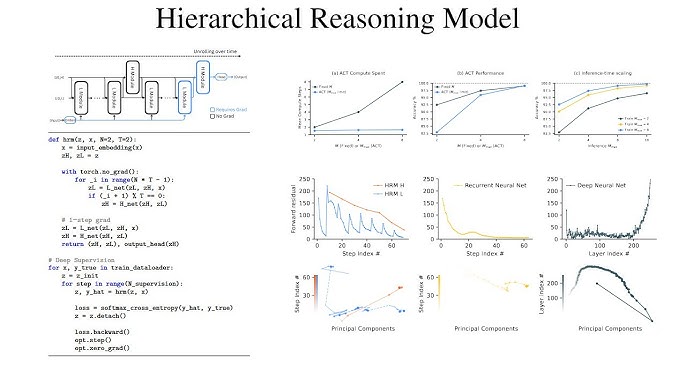
Hierarchical Reasoning Models (HRMs) combine layered cognitive architectures to improve task-specific problem solving. They pair a patient H-module with a fast L-module, yielding two-speed reasoning. Because modern large language models face diminishing returns under the bigger-the-better paradigm, HRMs offer a tactical alternative that balances representational depth and compute economy, and therefore they function as targeted architectures that allocate reasoning cycles adaptively, which improves sample efficiency and operational scalability for complex reasoning benchmarks, and they preserve robustness to task variation in sparse-data regimes. Analysts describe this shift away from “one-size-fits-all” thinking as a measured pivot toward specialized reasoning. Strategically, organizations can adopt HRMs to reduce inference cost while preserving task fidelity, because these models support Adaptive Computation Time and modular transformer blocks and because they enable fine-grained control over decision latency and accuracy, which makes HRMs pertinent for applications from algorithmic puzzles to real-world planning tasks and lower operational risk during deployment.

Market implications of Hierarchical Reasoning Models (HRMs)
Researchers report that Hierarchical Reasoning Models (HRMs) reconfigure competitive dynamics by prioritizing efficiency over scale. Because HRMs operate with roughly 27 million parameters and train on about 1,000 datapoints per task, vendors can lower dataset accumulation and infrastructure costs. As a result, smaller firms can compete on specialized reasoning tasks without matching the capital intensity of the largest model providers. Industry analysts interpret this shift as a tactical decoupling of capability from model size, and therefore they predict increased product differentiation in niche applications.
The operational case for HRMs centers on adaptive compute and modularization. The study shows that HRMs with Adaptive Computation Time reach peak accuracy with a budget of eight steps while consuming, on average, about 1.5 steps. Consequently, organizations can reduce inference spend and carbon footprint, and they can redeploy compute capacity toward parallel workloads. Corporate adopters will likely revise MLOps pipelines to support two-speed orchestration, because pipeline latency now affects service-level economics as much as raw accuracy.
Market stakeholders should also expect change in go-to-market strategies. Vendors that integrate HRMs can offer deterministic pricing and tiered SLAs, and incumbents that rely on scale may face margin compression. Benchmark evidence from the ARC repository supports these claims; relevant dataset details are available at ARC repository on GitHub. Moreover, empirical scaling research signals diminishing returns on model size, which further motivates the pivot to architecture optimization (see arXiv:2001.08361). Analysts recommend that leadership teams evaluate HRM pilots in constrained domains, and they note that measured deployment can yield competitive advantage while lowering systematic risk.
Finance
HRM use case
Hierarchical decisioning for fraud detection and dynamic risk scoring. H-module encodes long-term context. L-module processes rapid signals.
Strategic benefits
Lower inference cost and reduced latency, therefore lower operational spend. Enables specialized models without massive datasets.
Potential challenges
Regulatory explainability demands; integration with legacy risk systems.
Healthcare
HRM use case
Patient triage, diagnostic reasoning across multimodal inputs and workflow orchestration.
Strategic benefits
Improved accuracy in sparse-data regimes; therefore fewer labeled samples required. Supports deterministic clinical SLAs.
Potential challenges
Data governance, clinical validation, and patient safety certification.
Robotics and autonomy
HRM use case
Long-horizon planning paired with reactive low-level control. Two-speed reasoning supports both planning and reflexive actions.
Strategic benefits
Reduced real-time compute and faster decision loops, therefore better energy efficiency. Enhances mission-specific performance.
Potential challenges
Real-world robustness and safety-critical certification remain challenging.
Industrial automation
HRM use case
Process optimization and anomaly resolution across distributed control systems.
Strategic benefits
Deterministic performance and predictable compute budgets, therefore lower downtime risk. Improves maintenance scheduling.
Potential challenges
Integration complexity and sensor noise sensitivity.
Gaming and simulation
HRM use case
Procedural problem solving; maze and complex puzzle solvers such as 30×30 mazes and Sudoku.
Strategic benefits
High task fidelity with small datasets; thus faster iteration cycles. Enables niche product differentiation.
Potential challenges
Transferability to physical domains is limited.
Edge and IoT
HRM use case
On-device reasoning with constrained memory and latency budgets. ACT enables adaptive compute per input.
Strategic benefits
Lower power consumption and bandwidth savings, therefore reduced operating costs. Facilitates real-time features.
Potential challenges
Memory limits and secure model update logistics.
Strategic deployment of Hierarchical Reasoning Models (HRMs)
Corporations adopt Hierarchical Reasoning Models (HRMs) as targeted tactical levers to lower operational cost while preserving problem-solving fidelity. Because HRMs operate with roughly 27 million parameters and train on about 1,000 datapoints per task, executives can deploy specialized models without incurring hyperscale infrastructure expenses. Consequently, competitors that implement HRMs secure faster time-to-market in niche applications and can price services more competitively. Moreover, benchmark outcomes such as the ARC-AGI-1 results provide quantifiable evidence for these strategic claims (ARC-AGI-1 results).
In tactical scenarios, firms pair HRMs with Adaptive Computation Time to enable conditional compute budgets. For example, a financial services provider can use an H-module for portfolio-level reasoning and an L-module for tick-level decisions, thereby reducing latency and cost. Similarly, edge-focused vendors can embed HRMs to capture long-horizon context while keeping inference local, thus preserving bandwidth and privacy. The ACT literature supports this approach; foundational work is available at Adaptive Computation Time (ACT).
These strategies alter industry rivalry and innovation dynamics by shifting focus from brute-force scale to architectural efficiency. Incumbents may respond with broader modular offerings or tighter integration of MLOps, and startups can exploit lower capital requirements to enter specialist markets. Therefore, leadership teams should evaluate HRM pilots as strategic options for sustained differentiation and cost containment.
Hierarchical Reasoning Models (HRMs) recalibrate the trade-off between model scale and task efficiency. They combine a patient H-module with a fast L-module to deliver two-speed reasoning and selective computation. Consequently, HRMs achieve strong task fidelity while reducing dataset and inference costs.
For firms, this architecture translates into operational levers that influence product strategy and cost structure. Because HRMs use about 27 million parameters and train on roughly 1,000 datapoints per task, smaller vendors can compete. Therefore, incumbents may face pressure to adopt modular offerings or optimize MLOps for two-speed orchestration.
Benchmark evidence indicates HRMs outperform larger models on structured reasoning benchmarks, which supports strategic pilots. Moreover, Adaptive Computation Time enables conditional compute budgets and lowers average inference steps. In sum, executives should treat HRMs as tactical architecture choices that can deliver differentiation, cost reduction, and controlled risk.
Frequently Asked Questions (FAQs)
What are Hierarchical Reasoning Models (HRMs) and how do they function?
Hierarchical Reasoning Models (HRMs) implement a layered architecture that separates slow, deliberative processes from fast, reactive ones. The patient H-module encodes long-term context, while the L-module executes rapid, low-level operations. Both modules use transformer blocks, and Adaptive Computation Time trains a stopping policy via a Q-learning paradigm. HRMs operate with about 27 million parameters and train on roughly 1,000 datapoints per task.
How do HRMs compare to larger language models in capability and efficiency?
HRMs prioritize task-specific efficiency rather than sheer scale, and empirical benchmarks support that trade-off. For example, HRMs achieved 40.3% on ARC-AGI-1, while Claude 3.7 scored 21.2% and o3-mini scored 34.5%. Consequently, HRMs deliver competitive structured-reasoning performance with far smaller parameter counts.
What operational advantages do HRMs provide for enterprise deployment?
HRMs reduce inference cost through conditional computation, because ACT lets the model stop early when confident. The ACT-enabled HRM reaches peak accuracy with an eight-step budget but averages about 1.5 steps. Therefore, organizations can cut compute spend and lower latency while maintaining top-tier accuracy.
Which industry applications suit HRMs and what are typical barriers?
HRMs fit domains that require long-horizon planning and fast reactions, such as finance, healthcare, robotics, and edge computing. Strategic benefits include sample efficiency and deterministic compute budgets. However, barriers include regulatory explainability, clinical validation, and system integration complexity.
What governance and strategic considerations should leaders weigh?
Leadership should evaluate explainability, safety certification, and MLOps readiness before scaling HRM pilots. Moreover, measured pilots in constrained domains reveal operational trade-offs. Therefore, executives gain evidence for strategic deployment while limiting adoption risk.
